
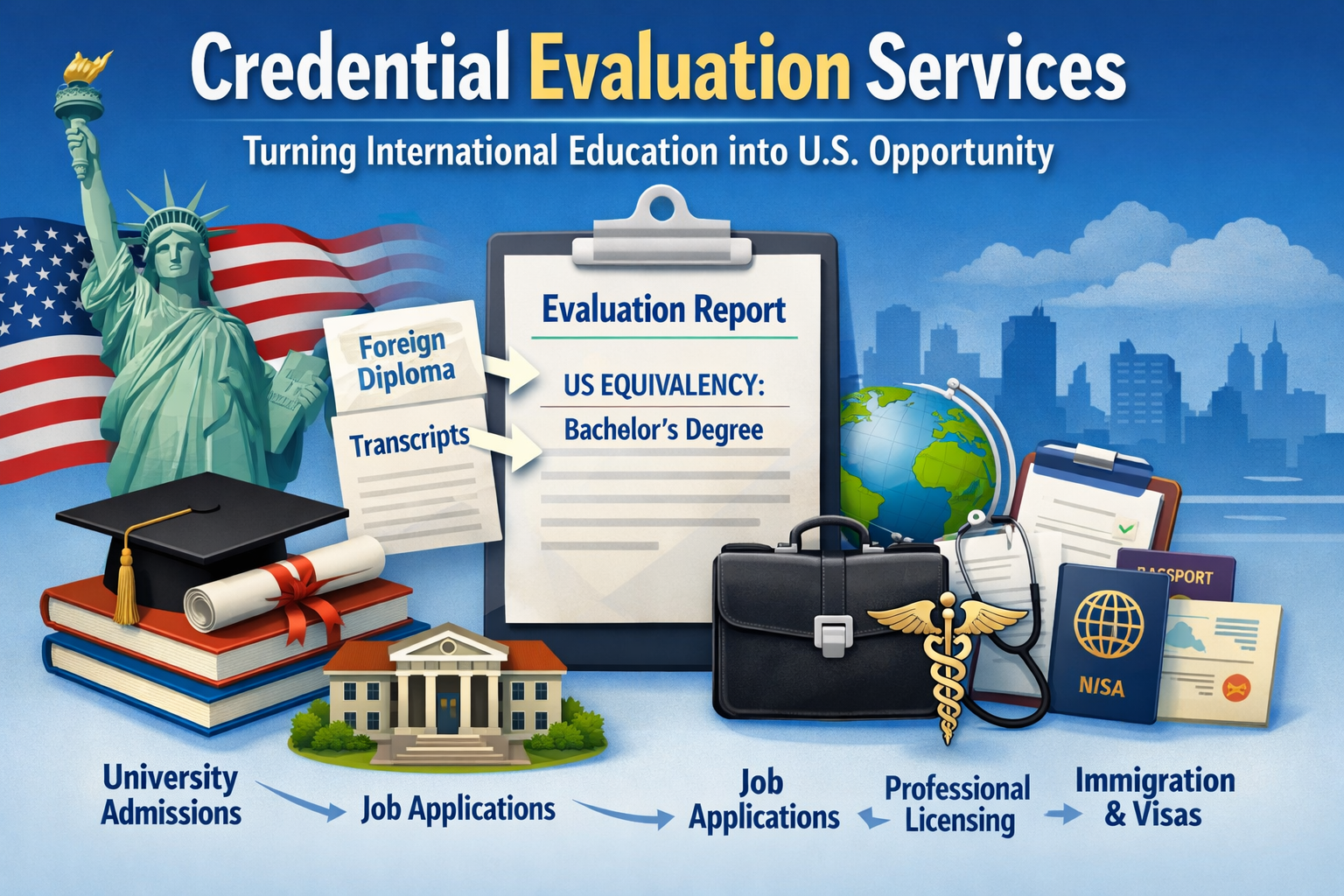
Moving to the United States with an international degree often raises one big question, how will your education be understood here? Universities, employers, and licensing boards do not automatically recognize foreign credentials, even if they come from well known institutions. This is where credential evaluation services play a critical role, translating your academic background into clear U.S. equivalency so decision makers know exactly what your education represents.
For students, professionals, and immigrants, credential evaluation is often the bridge between past effort and future opportunity. Without it, degrees and certificates can feel invisible.
What credential evaluation services actually do
At the most basic level, credential evaluation services compare education completed outside the United States with U.S. academic standards. This is not a simple conversion or guesswork exercise. Evaluators review transcripts, diplomas, grading scales, course content, and institutional recognition.
The result is a formal report that explains:
- The U.S. level of education equivalent to your foreign degree
- The credit hours and grading scale in U.S. terms
- The academic standing of the institution you attended
- Any professional relevance tied to your field of study
This report becomes an official document that schools, employers, and government agencies can rely on.
Why credential evaluation matters more than people expect
Many people assume that showing a diploma is enough. In reality, U.S. institutions need standardized comparisons to make fair decisions. A bachelor’s degree from one country may be equivalent to a U.S. bachelor’s, a master’s, or sometimes a different level entirely.
Credential evaluation services remove confusion and guesswork. They give your education context, clarity, and credibility. Instead of leaving decision makers unsure, you provide them with a trusted explanation they can confidently use.
Common situations where credential evaluation is required
Credential evaluation services are used across many life stages and goals. Some of the most common include:
University admissions
Colleges and universities often require evaluated credentials before accepting international students. Admissions teams need to know if your prior education meets entry requirements for undergraduate or graduate programs.
Professional licensing
Fields like engineering, healthcare, teaching, and accounting frequently require credential evaluation before licensing exams or approvals. Regulators must verify that your education meets U.S. professional standards.
Employment applications
Many employers request evaluated credentials, especially for roles requiring specific degrees. An evaluation helps HR teams understand your qualifications without confusion.
Immigration and visa support
Certain visa categories require proof of education equivalency. Credential evaluation services help demonstrate that your background meets U.S. educational requirements.
How VeriEval supports this process
VeriEval focuses on making credential evaluation accessible and understandable. The process begins with a free pre-evaluation, which helps applicants understand whether their credentials are eligible and what type of report they may need.
From there, VeriEval guides clients step by step:
- Reviewing academic documents carefully
- Matching international education to U.S. standards
- Preparing a clear, professionally written evaluation report
- Delivering results that institutions can trust and accept
This approach reduces uncertainty and helps applicants avoid delays caused by incorrect or incomplete evaluations.
Types of credential evaluation reports
Credential evaluation services typically offer different report types depending on the purpose.
Document by document evaluation
This report summarizes each credential and states its U.S. equivalency. It is commonly used for employment and immigration.
Course by course evaluation
This detailed report lists individual courses, credit hours, and grades converted to U.S. standards. It is often required for university admissions and professional licensing.
Choosing the correct report type is important. Submitting the wrong one can slow down applications or result in rejection.
What makes a credential evaluation credible
Not all evaluations are viewed equally. Institutions look for accuracy, consistency, and transparency. Strong credential evaluation services rely on:
- Recognized academic databases
- Country specific education systems knowledge
- Clear methodology
- Professional formatting and language
VeriEval emphasizes clarity, helping institutions quickly understand how conclusions were reached without confusion or vague statements.
Preparing your documents for evaluation
Before submitting credentials, preparation matters. Clean scans, complete transcripts, and accurate translations help evaluators work efficiently. Missing pages or unclear documents can delay results.
Credential evaluation services often provide guidance on what to submit and how. Following these instructions carefully saves time and avoids repeated requests.
The long term value of credential evaluation
Once completed, a credential evaluation report can be used multiple times. You may apply to different schools, jobs, or licensing boards without starting from scratch. It becomes a reusable asset that supports your professional and academic journey.
More importantly, it restores value to education you already earned. Years of study and effort deserve recognition, not confusion or dismissal.
Credential evaluation services turn international education into something the U.S. system understands, respects, and can act on. When your background is clearly explained, doors open in ways that paperwork alone never could, and the story of your education finally speaks the same language as your future plans.








Leave a Reply